| CITROËN BX do-it-yourself |
|
|
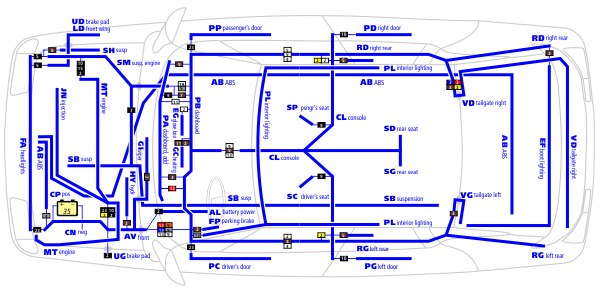
CoolingFinding the cause of overheatingCheck the coolant fluid level on a cold engine. If it is low, especially if you have a coolant leak, you might have found the problem right away. Otherwise, start with checking the fuses #1 and #4 on Series II models or #5 on the older ones. If they are OK, put your finger on the leftmost relay behind the fuses; when you turn the ignition on (don't start the engine), it should click. If it doesn't, replace it. If you have electric windows fitted, either the second relay from the left or the second from the right would be of the same type as the one serving the cooling fan; you can use them as a quick roadside replacement. 14 engines: The fan control switch is screwed into the right bottom of the radiator. It has two blue wires, the feed coming from the relay has a mauve sleeve, the other going to the fan has a yellow one. Jumper these two connections. If the fan does not start, check the wire leaving the fan for a common ground behind the battery. 16 and 19 engines: The fan control switch is screwed into the right bottom of the radiator. It is a double temperature switch with three blue wires: the ground has a brown sleeve, the low speed contact has a yellow one and the high speed contact has no sleeve. Jumper the brown to the yellow and the fan should rotate in low speed. Jumper the brown to the sleeveless and the fan should rotate in high speed. If it does not work in either speed, check its ground: touch the wires mentioned above to some exposed metal part instead of the brown sleeve wire. If only the low speed fails, the low speed resistor (an aluminum cylinder with a 3-pin white connector at one end) located right behind the left headlamp is suspect. With air-conditioning: These models have two fans. In low speed, they are connected in series, so both should run (and because of the circuit, if one fails, the second fan stops running, too). In high speed one fan is always running, the second is switched on together with the A/C. The fan control switch is the same as with other 16 and 19 engines, the green wire serves the high speed and one of the blue wires the low speed (the other blue wire is earth). To check the high speed, touch the green wire to some exposed metal part: with the A/C on, both fans should run in high speed, without the A/C only one of them. To check the low speed, touch one of the blue wires to earth (if nothing happens, try the other blue wire): both fans should run in low speed. As the low speed is obtained by using both fans, there is no low speed resistor on these models. Although no circuit diagrams I have describes this, there are a few 16 or diesel models out there with their control switch connected the BX 14 way, between the positive feed from the relay and the fan instead of between the fan and the ground. Check for this situation first before you jumper anything to the ground. If this resistor fails (or is missing by any chance), replace it as soon as you can. It's very easy to test: feel it with your fingers after a trip in town. If it feels warm, it was working (caution! it might be hot!). At first sight this resistor doesn't seem to be very important (if the fan doesn't start at 88 °C, it will at 92 °C, the engine will not overheat, so why bother?) but it is an essential part of the system. Starting the fan in a high speed from stillstand requires significantly more current than the amount consumed either in low speed start, low-to-high speed transition or when running at any steady speed. Thus, in order to reduce the strain on the temperature switch, it starts in low speed and switches to a higher one when required. Consequently, if the resistor circuit is malfunctioning for any reason, the wear of the temperature switch is accelerated seriously. Wearing of this switch means that its switching temperature will rise continuously, reaching a point when the engine overheats without the fan starting even once. So, if the fan is working as it should, check that temperature switch. The most precise way would be to remove the switch and test, however, you can make a simple but sufficient test in the car. In a cold engine, make sure that the coolant fluid level is OK, start the engine and run it at high idle (it is much easier if you ask somebody to help you). As the engine warms up, the radiator stays cold for a while (feel both the rubber hose between the thermostat and the radiator and the radiator itself at the left side with your hand; as the thermostat is still closed, no coolant—no heat, that is—should come that way). As soon as the temperature reaches around 80 °C, it should open, sending the coolant through the radiator. If the hose and the radiator stays cold above 80 °C although the engine temperature rises steadily, the thermostat does not open and should be replaced. If the engine temperature rises faster than it normally used to be, start the heater inside the passenger compartment and set the temperature and the blower speed to the maximum. If you find the air entering much cooler than the engine temperature should dictate, the coolant might not circulate because of the malfunction of either the coolant pump drivebelt or the pump itself. If the thermostat does open, watch carefully. As the temperature goes up, the fan should cut in. In 14 engines, that would happen above 90 °C; in 16/19 engines it cuts in below 90 °C at low speed. In the later case, disconnect the resistor behind the headlamp quickly. The fan stops, the temperature rises. Above 90 °C, the fan should cut in again, this time in high speed. If it does or you have a 14 engine and the fan did start above 90 °C, stop the engine: everything seems to be fine. Don't forget to reconnect the resistor. If the fan remains still, the control switch is probably at fault. The warning lamp (even the flashing or yellow pre-warning light with models without a temperature gauge) comes to life way above the fan cut-in temperature. If the fan doesn't start even when the warning light goes on, the temperature switch is dead without any doubt. Tell your assistant to shut off the engine as soon as the warning comes on; there is no need to overheat the engine once more. If everything else is perfect and the engine still overheats, you might suspect the radiator. When the engine is hot, touch various parts of the radiator looking for cooler spots. If you found some, drain the coolant and remove the radiator. You can try to flush out the blockage directing a flow of water into it. Reversing the flow (entering into the bottom hose) and using some cleaning agent as Holts Radflush or Speedflush might remove bad contaminations as well. If this doesn't help, you'll have to find a radiator repair specialist or to replace it with a new or reconditioned unit. If your BX only has warning lamps instead of a temperature gauge (most of them have no gauge), you should proceed the same way: check the thermostat first, then wait for the fan to cut in. Constantly monitor the warning lamps. If the fan does not cut in before the warning starts to flash or light, the control switch has to be replaced. Emergency repairs
Leaks at the thermostat (diesel)The fuel heater leaking on the thermostat O-ring seal seems to be a typical problem. The same part also appears on the CX 2.2 and 2.5 diesel, 2.5 turbo (both I and II) as well as some BX 17/19 D engines. It is mounted on the side of the engine head on the gearbox side, covering a large hole. It is in direct contact with the coolant. The leak results in fuel flowing back to the tank when the engine is not running, and bubbles getting into it when it runs. A pressure test will not reveal the failure because the thermostat will tend to be pushed out and this will squeeze the O-ring and make it seal temporarily. A telltale sign is when you can start the engine on the first crank but it just dies after a few seconds, and won't restart until you prime it using the small pump on top of the fuel filter. There is no replacement O-ring available from Citroën and it is accessible only with great difficulty. You can buy the whole heater for an exorbitant price and it takes a lot of work to change it, too. You should try to locate an O-ring of the same size from another source. Note that Lucas, CAV and Rotodiesel pumps are extremely sensitive to air in the fuel and will resist all attempts to get it working properly under such conditions. The effect will sometimes be subtle, sometimes brutal: the engine might have problems with idle speed (both lower and higher than usual) which seem to correct themselves suddenly. But then, you can also have it refuse to drop lower than 2000 rpm. Željko NASTASIĆ Leaks in the cooling systemAvoid products which claim to block any leak from the inside (Holts Radweld and similar). They can clog more than the leak itself, the heater matrix or the smaller passages inside the engine might suffer. Do it properly and thoroughly instead. First of all, locate the leak. Look for the usual whitish residue around hoses and clips. If a hose is ruptured, replace it (on the roadside, you can use Holts Hoseweld to bandage a hose but replace it with a new one as soon as you can). If the heater matrix is leaking, replace or repair it. If you found a hole in the radiator, use Loctite Quick Solder Radiator Repair or similar. It looks very much like a child's dough but it is made of two components. When you knead the two layers into one, it becomes soft like a putty but will harden like brass in an hour. With this putty you can fill any hole or leaking part. As this is an external repair (and you wait for the glue to harden before you restart the engine anyway), it presents no risks for the cooling system. Alternatively, you can go to a radiator specialist who can simply solder it the traditional way. Still significantly cheaper than a new radiator... Retrofitting a coolant temperature gaugeThis is rather easy on the Series II models (but read on, we have some ideas for Series I, too). The modification has been done on various models already: 15 TGE, 19 TRI, 19 TRS, 17 TZD turbo, 19 RD, 19 TZD. As far as I know, the exact same procedure should apply to all BX 15/16s (but it would be nice if someone could try and inform me about the results). Part of the modification might work on a BX 14, too (temperature meter but no warning lamp). The BX 16/19 has two coolant temperature switches screwed into the back of the thermostat housing. The thermostat is located on the left of the engine, beneath the distributor. The switch with the blue connector actuates the yellow pre-warning lamp at about 105 °C, the yellow connector the red warning lamp at 112 °C. In contrast to this, the GTi has a switch for the red warning lamp and a sensor for the meter itself. The switch is identical, however, the sensor is different. What you needThe modification entails replacing the blue connector switch (105 °C) of the 16/19 with the temperature sensor of the GTi, and the instrument panel of the 16/19 with that of the GTi. The original wiring of the switch will serve the sensor without additional modification. Hence, these are the two parts you have to acquire somehow.
Look for a donor car without air conditioning as those have different, double function temperature switches with two connectors. It is not a problem if you have aircon yourself, you can use the other hole in the thermostat housing—originally plugged with a screw—to install the new sensor. There will be one difference, though: the wires of this double function switch do not go straight to the dashboard as in cars without AC but are connected to a relay unit. Therefore, you cannot simply use these wires already in place (cutting them would stop the AC), you have to put a new wire between your new sensor and the instrument panel gauge yourself.
And if you did find a GTi in the salvage yard, don't leave its instrument panel alone (the one on the picture comes from a Peugeot GTi; although its design is slightly different, it is fully compatible with the BX panels). If the yard people are friendly enough you might be able to test it to see if it works OK (either in the GTi, if it is still intact to this extent) or in your own car. With some previous experience, you can dismantle your dashboard on the spot in less than ten minutes (you can drive up with the screws already removed), fit the GTi panel and see if everything works all right. Some blown light bulbs are not a catastrophe, minor scratches or discolorations can also easily be repaired, as you will have two instrument panels to combine into one. However, the meters (speedo, tacho and the four corners) should work. You might be able to swap some of them between your original and new instrument panels, however, this might require major dismantling of the unit, so it's not for the fainthearted. But if you want to have your original tachometer back with your original redline zone, you have to take this route. It is advisable to do so because, if the redlining is incorrect, some nitwit at a garage might not pay attention and torture the engine into too high a revolution during some tests or repairs. Some parts (eg. the delay module of the oil level/oil pressure meter in the upper left corner) even differ in the electronic panel, so swapping is not an option there. In a diesel you'll have to combine your two panels into one, anyway, as the tachometer is not compatible. Don't forget to remove the bulb of the yellow warning light, leaving it there would upset the meter. For a few days Jens and I thought about sparing the GTi panel and using the oil pressure meter which is idle after the initial delay period when it shows the oil level. However, this meter is so idle that it doesn't have the necessary circuits and connections in the TRS/TRI instrument panel. Fitting the sensorFirst of all, start with a cold engine: the thermostat, the engine head and the coolant fluid must be cold. There is no need to drain the coolant if you follow my advice; the coolant loss will be negligible. To facilitate your work with the switches and sensors, you need to remove the distributor. You should consider buying a new O-ring seal for the distributor base. If you have suspicious oil leakage around the distributor base, above the thermostat, don't even consider but buy a new seal anyway. After all, it costs less than a regular cheeseburger... Unclip and remove the distributor cap. Disconnect the spark plug HT leads from the distributor, noting which goes to which plug. Before you remove the distributor, don't forget to scribe an alignment mark accross the distributor and the housing so that you can refit it in exactly the same position. Clean the area around the distributor mounting, undo the retaining nuts and withdraw the unit; be prepared for a few drops of oil to spill. You might place a rag beneath the distributor beforehand. Locate the switch with the blue connector attached. Just to be sure that you don't remove the wrong switch, disconnect its wire, touch it to a metal part in the vicinity and check if the yellow warning lamp is lit on the instrument panel. You need to remove this switch, and leave the other one alone. Clean the neighborhood of the switches. Loosen the switch with a 16 mm spanner or socket; but don't yet remove it. Have the new sensor in your hand. Remove the switch turning it by hand, cover the orifice with your finger to prevent the coolant from flowing out and fit the sensor in its place. If you act quickly, only a few drops of coolant will be lost. Don't overtighten the sensor. Replace the wire. Refit the distributor. The drive is offset, so don't be afraid of fitting it the other way round. Use a new O-ring seal if you have one. Use the alignment marks to refit into the correct position. If possible, check the ignition timing (or have it checked). Check and top up the coolant if necessary. Replacing the instrument panelFirst of all, a word of caution. The following description is based on my own car and the Haynes manual. As far as I know, all Citroën and Peugeot GTi instrument panels (manufactured by Veglia, part number 7/19/xx_22 k 6V located near the bottom edge of the speedometer, the xx may vary) are born equal (at least functionally, as there are slight aesthetical differences in the digits and markings on the front panel), before cutting any wire or soldering new ones, check with a multimeter or a test lamp that yours functions the same way. Connect your GTi panel (don't even bother with fitting it into the facia panel, you'll have to remove it again shortly) and check that everyting (expect the new meters, of course) works satisfactorily. Remove it again and let's see how we can connect the sensor wiring. When you removed your old panel, one of the connectors was a white 2-pin one, with only one wire connected. It snapped into a receptacle near the bottom of the tachometer. This is the wire coming from the 105 °C switch to the yellow warning lamp, the third from the bottom just above the connector. In the GTi panel, this bulb slot is probably empty, as it is not used. But if you twist a bulb holder into it (just use any of the bulbs on the panel for a moment) and apply 9-12 V to pin 5 of the fourth connector of the top edge and ground the lower pin of this small connector, the lamp will be lit. You won't see it from the back side, only from the front. The temperature meter is to the left of the connector, its three connections are secured by nuts to the flexible printed circuit board. The rightmost one, closest to the connector is the feed from the sensor, connected to pin 6 of the first connector of the top edge (you can follow the wiring on the circuit board to the connector easily). Our task is to connect these two circuits somehow. I found three viable solutions (equivalent in practice):
Finally, refit the instrument panel into the facia and the whole enchilada to the dashboard. The speedometer cable can be reconnected by simply pushing it onto the meter stub (apply a little grease first, though, speedos tend to wobble anyway). The next step?You have two other meters in the instrument panel still idle: oil pressure and oil temperature. There is no wiring for them in smaller models, however, this shouldn't be a problem: just two wires going the same route the oil pressure switch wire goes, entering the engine compartment through the bulkhead under the battery (remove the battery to see and to install), crossing over the clutch cable, under the inlet manifold. The oil pressure warning switch is located above the oil filter, on the front of the engine. A little to the right and upwards, you'll find a bolt. This bolt occupies the place of the pressure sensor. Remove the bolt (there is no oil pressure if the engine is not running, so there is no need to drain the oil, not even a drop will flow out from the hole) and fit the sensor in its place. Access is very difficult to this spot (unless you remove the alternator or the inlet manifold) but I am the living proof that it can be solved without removing those parts, reaching down with one hand through the manifold, with the other from the front, behind the radiator. Some of the hoses might block the way, remove or relocate them if necessary. If you plan to change the oil in the engine, fit the sensor at the same time. When the oil filter is removed, you can reach the pressure sensor from the bottom. Needless to say, don't try this with a hot engine... The oil temperature sender is screwed into the sump pan on GTis. On my TRI, I found no hole for this purpose, meaning that it cannot be solved without replacing the sump pan. If you plan to revive these meters as well, then the third connecting method (adding new pins to the white top edge connector) seems to be the best. The coolant temperature sensor came through pin 6, the oil pressure sensor should be connected through pin 2 and the oil temperature sensor through pin 7. But I have a Series I BX!Catalin wrote the following: "I own an '86 BX 19 GT with a Lego dashboard. After a quick check I found that it is very easy to install a supplementary sensor and a meter. [...] Just find a pair of supplementary meter and sensor from another car. VW Golf GTI, Audi 80 GTE, etc. have round meters on the center console. It is very important to have the meter coupled with its original sensor as their internal resistance differs from one another. The new sensor may require rethreading. The original thread is M14×1.25. After replacing it, make sure it doesn't leak (you may use some special sealant). I made a plastic box (dimensions: 7×7×10 cm) and screwed it to the left side of the steering column (just under the instrument panel). The wiring is very simple, only three wires: positive feed, ground, sensor. I put a similar box on the the right side (just behind the ignition key) with an oil pressure meter. As the older engine had no hole for the pressure sensor, I needed an additional bronze housing fitted to the engine, housing both the pressure switch and the sensor." | ||
|
Webmaster: Gábor DEÁK JAHN. Visitors: 235,510 Page hits: 607,371 Since: June 5, 2003 |